6-7 MINUTES READING TIME · 9 June 2026
Industrial photography often looks calm and controlled in the final images.
Clean lines. Organised spaces. Professional working environments. Clear visual documentation of a completed facility. From the outside, it may seem like the photographer simply arrives, sets up the camera, and captures what is already there.
The reality is very different.
A recent assignment inside a newly completed pharmaceutical facility in Tuas, Singapore reminded me that industrial photography is not only about producing strong images. It is also about preparation, security clearance, safety procedures, site access, communication, timing, and knowing how to work inside an environment where every movement has to respect the facility’s rules.
The final images were mainly required for award submission, so the purpose was not just documentation. The images needed to present the facility with clarity, scale, operational readiness, and professional credibility.
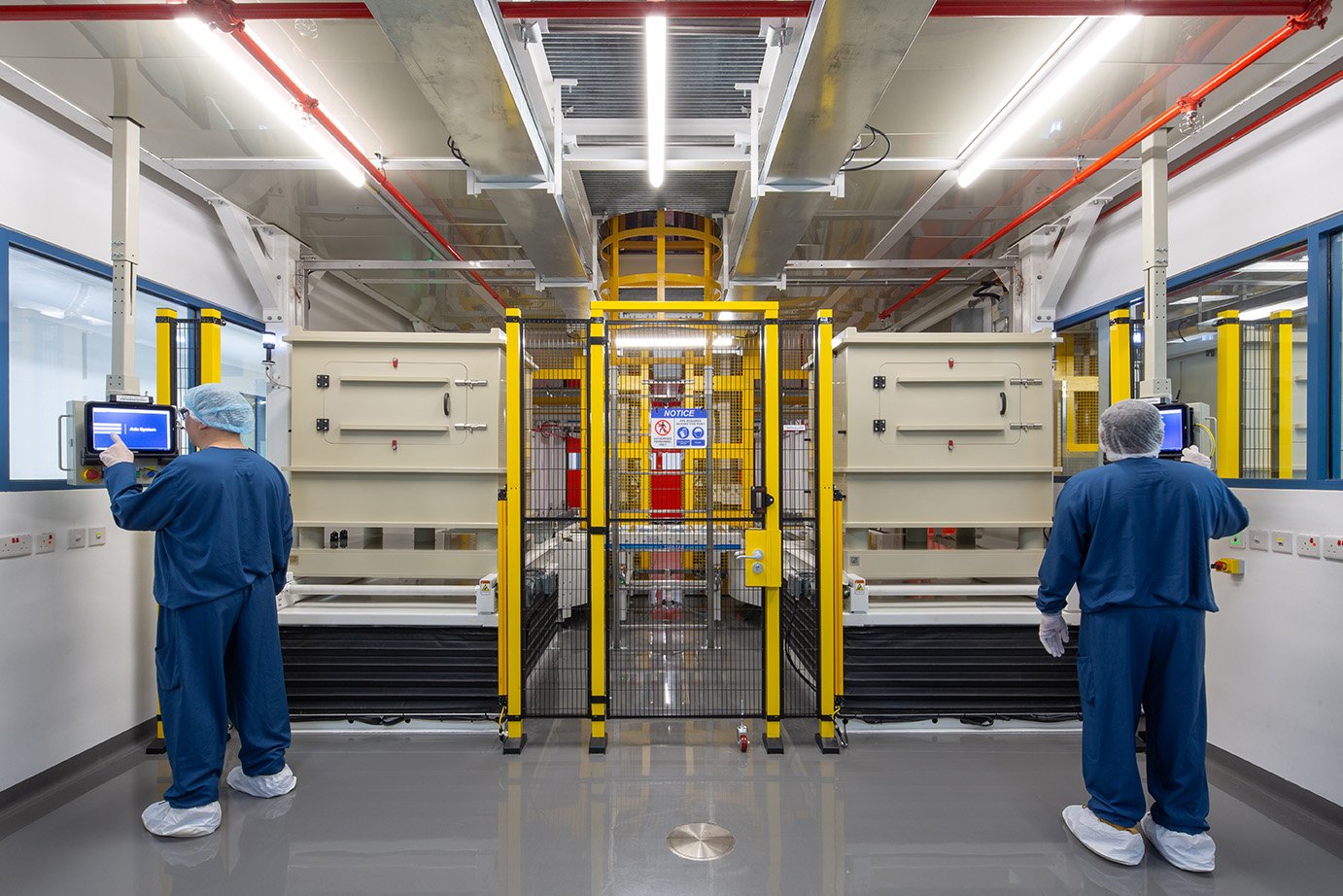
Staffs in clean suit working on the touchscreen panel
Table of Contents
The Project Started Long Before the Shoot Day
The first enquiry for this project came in November 2024.
I sat through a detailed briefing call with the architect, and the discussion was already quite intensive. We went through the requirements, specifc angles, visual approach, and how the images might be used. At that stage, it sounded as if the shoot was going to happen soon.
But the project was later called off because the site was still a work in progress.
For a while, I thought the assignment might be cancelled completely. Industrial and construction-related projects do not always move according to the original timeline. Site readiness, access approval, completion stages, safety requirements, and internal coordination can all affect when photography can actually take place.
Almost one year later, the project came back.
By then, the requirements had changed, the shooting duration had changed, and the client’s needs had become more specific. This is one of the realities of industrial photography. The brief can evolve because the site itself evolves. What matters is not only what was discussed at the beginning, but what the project needs when the facility is finally ready to be photographed.
A Site Recce Is Not Just About Looking for Angles
For this assignment, the site recce was essential.
In a normal environment, a recce may simply mean walking around, checking the light, understanding the space, and planning possible compositions. Inside a restricted industrial facility, the process is more involved.
Travelling to the Tuas area takes time. Security clearance takes time. Waiting for the relevant personnel takes time. Moving through different gates and access points takes time. Even before the camera comes out, there is already a lot of coordination happening behind the scenes.
The recce helped me understand the facility layout, the sequence of areas, the practical shooting angles, and how movement would work on the actual shoot day. After the site walk, there was further discussion back at the client’s office. On the backend, vendor forms and administrative requirements also had to be completed.
These details may not sound visual, but they directly affect the photography.
When access is controlled, the photographer cannot simply improvise freely on the day itself. Preparation becomes part of the creative process. Knowing where to go, what to expect, what can be photographed, and how much time each area may require helps prevent confusion during the actual shoot.
Clean-Room Protocol Changes the Pace of Photography
I have photographed many industrial environments over the years, but wearing a clean suit was still something new for me.
It made me slightly more cautious, not because the photography itself was unfamiliar, but because clean-room protocol adds another layer to the workflow. There are different layers to wear. Everyone has to be ready before entering. Gear has to be checked properly. After finishing one area, you may need to exit, remove the suit, move to another location, and suit up again if required.
This changes the pace of the shoot.
An 8-hour shooting window may sound like a lot of time, but it is not the same as 8 hours of uninterrupted photography. Some of that time is spent on access, movement, waiting, PPE, safety coordination, gear checks, and transitions between areas.
Inside a restricted facility, time is not only shooting time. It is access time.
That is why planning matters. Every area has to be approached with intention. Once an area is completed and cleared, you do not want to keep turning back unless there is a strong reason. The workflow has to be disciplined, because every repeated movement may involve more coordination.
Safety Escorts and Access Control Shape the Way You Work
There were safety escorts with us throughout the shoot.
This is expected in a restricted pharmaceutical facility. The site is not a place anyone can enter freely. Security is tight because of pharmaceutical production, clean-room protocols, safety controls, proprietary equipment, and access approval.
Within an approved area, there may still be some flexibility to move and refine angles, but that does not mean roaming around without awareness. You have to stay close enough to the group, understand the boundaries, and respect the instructions given by the site team.
This is where experience matters.
A photographer working in this type of environment needs to stay calm and observant. You cannot behave as if the site exists only for photography. It is still a working facility, and the photography has to fit into the environment without disrupting the people, safety procedures, or operational flow.
Preparation Matters More Than Pure Creativity
In a restricted industrial facility, creativity still matters, but it cannot be the only thing the photographer depends on.
The shooting scenes can be limited. The access routes are controlled. The angles may already be partly pre-planned. There may not be much room to “play around” endlessly.
This does not mean the images have to be boring. It means the photographer has to work with sharper judgement.
The aim is to show the scale, depth, operation, cleanliness, and professional quality of the facility. In this type of environment, strong images often come from making small but important decisions: where to position the camera, how to show depth, how to include people naturally, how to avoid visual clutter, and how to make the space feel credible without exaggerating it.
Preparation gives creativity a realistic structure.
Without preparation, the photographer may spend too much time searching. With preparation, the photographer can focus on making the available angles stronger.
Bright Spaces Are Not Always Easy to Photograph
One thing that can be misleading is the brightness of the space.
A pharmaceutical facility may look clean and brightly lit to the eye, but that does not always mean it is bright for the camera. Depending on the area, it can still be a low-to-medium light environment from a photography perspective.
Shutter speed can become tricky if you are not careful, especially when people or operational activity are included. A scene may look visually clear, but the camera still needs enough light to produce sharp, usable images.
For this assignment, flash and tripod were allowed, which helped. But equipment alone does not solve everything. The photographer still needs to decide when to work from a tripod, when to adjust the exposure, when to include people, and when to keep the setup simple so the shoot can continue efficiently.
Industrial lighting is rarely about making everything dramatic. More often, it is about making the environment clear, accurate, professional, and useful for the client’s intended purpose.
Working With People Requires Clear and Fast Communication
When people are available inside the facility, I prefer to include them where it makes sense.
People help show scale, operation, and purpose. They make the facility feel active rather than empty. But in an operational environment, people are not models. They may be working, waiting for instruction, following safety procedures, or focused on their actual tasks.
This means the photographer has to communicate quickly and clearly.
If I am unsure what a certain area, equipment, or process is, I ask. I do not try to act smart or pretend to understand everything. Asking the right question helps me photograph the scene more accurately and avoid making wrong assumptions.
When directing people, the instruction has to be simple. There is no point making someone do A, B, C, and D just because I am still searching for the image. People may not have the time to entertain unnecessary direction, especially when operation is ongoing.
A small adjustment can be enough.
Turn slightly. Pause for a moment. Continue the task. Stand where the scale of the facility becomes clearer. These are practical directions that respect the working environment while still improving the image.
The Exterior Architecture Required a Different Kind of Effort
The assignment was not only about the interior facility areas.
There was also an exterior architecture component, and that created a different challenge. Inside the facility, movement was controlled. Outside, I had more room to move around, explore angles, and stretch my legs.
But exterior photography in Singapore also means dealing with heat, humidity, and the afternoon sun.
For the architecture, the challenge was to work through various angles and present the facility with scale, structure, and presence. Compared with the restricted interior areas, the exterior gave more room for composition. But it was also physically demanding in a different way.
This contrast is part of industrial photography. One part of the assignment may require tight control, safety awareness, and limited movement. Another part may require physical endurance, patience, and careful observation of light and building form.
What This Assignment Reinforced for Me
This assignment reinforced something I already believe strongly about industrial photography.
The final images are only one part of the work.
Behind those images are briefings, delays, changing requirements, site readiness, security clearance, vendor registration, safety escorts, PPE, clean-room procedures, gear checks, lighting judgement, fast communication, and the discipline to work within real operational limits.
For clients, these details may not always be visible.
But they matter.
A photographer working inside a restricted industrial facility needs more than camera skill. The photographer needs to understand preparation, access control, safety discipline, site behaviour, and how to stay calm when the environment is not flexible.
This is especially important when the images are required for award submission, corporate presentation, or professional documentation. The images must not only look good. They must support the credibility of the facility and the people behind the project.
That is the reality of photographing inside a restricted industrial facility in Singapore.
The work begins long before the shutter is pressed.
For companies preparing industrial photography for a facility, manufacturing plant, pharmaceutical environment, engineering operation, or award submission, proper planning can make a significant difference to the final images.
You can view my industrial photography services in Singapore here:
Industrial Photography Service Singapore
For more related insights, you may also read:
Industrial Portrait Photography in Singapore: Experience Matters Beyond the Camera
Why Site Scouting Matters Before an Industrial Photography Shoot in Singapore